
How do you modernize corporate training into microlearning?
To modernize corporate training into microlearning, L&D teams must systematically deconstruct long-form, multi-hour courses into short, single-concept digital assets that target one specific behavior change. This modernization process requires auditing your current content library, stripping away non-essential background theory, mapping learning chunks to immediate on-the-job actions, and selecting highly visual delivery formats like animated scenarios or interactive screencasts. By shifting from macro-learning to a structured library of bite-sized modules, organizations can dramatically lessen cognitive overload, smoothly integrate development into the daily workflow, and deploy agile microlearning solutions that keep pace with fast-changing business needs.
Many organizations are still relying on a legacy training paradigm: dragging employees away from their primary jobs to sit through a grueling 60-minute compliance webinar or an exhaustive three-day onboarding seminar. While the completion rates on these programs might look passable on paper, the practical impact on performance is often negligible. The human brain simply isn’t designed to retain a firehose of information delivered in a single, massive block.
Modernizing your legacy corporate assets into microlearning isn’t about taking a giant pair of scissors to a 40-page PDF or slicing an hour-long Zoom recording into twenty random 3-minute clips. It requires an intentional framework that respects your learners’ time, limits cognitive demand, and corresponds content with immediate business needs. In this guide, we will break down exactly how to convert your traditional assets into high-impact microlearning. To see how we build customized, high-converting learning paths from scratch, check out our custom eLearning services.
Grasping the Core Benefits of Microlearning
Before altering your instructional design pipeline, it is critical to understand why this shift matters to your leadership team. When you pitch corporate training modernization to stakeholders, you must frame the argument around the measurable benefits of microlearning:
- Unmatched Workflow Integration: Rather than scheduling chunks of non-productive time, employees can consume a 2-minute module directly at their desks or via mobile devices between tasks.
- Higher Knowledge Retention: By focusing on one micro-concept at a time, you prevent mental overload, leading to vastly superior long-term recall.
- Faster Development Cycles: Updating a standalone 90-second video to reflect a new product feature or compliance rule is exponentially faster and more cost-effective than rebuilding a massive legacy course.
- Targeted Performance Support: Microlearning functions as a powerful “just-in-time” performance aid. An employee who forgets a software step can quickly query and watch a single micro-module to resolve the issue immediately.
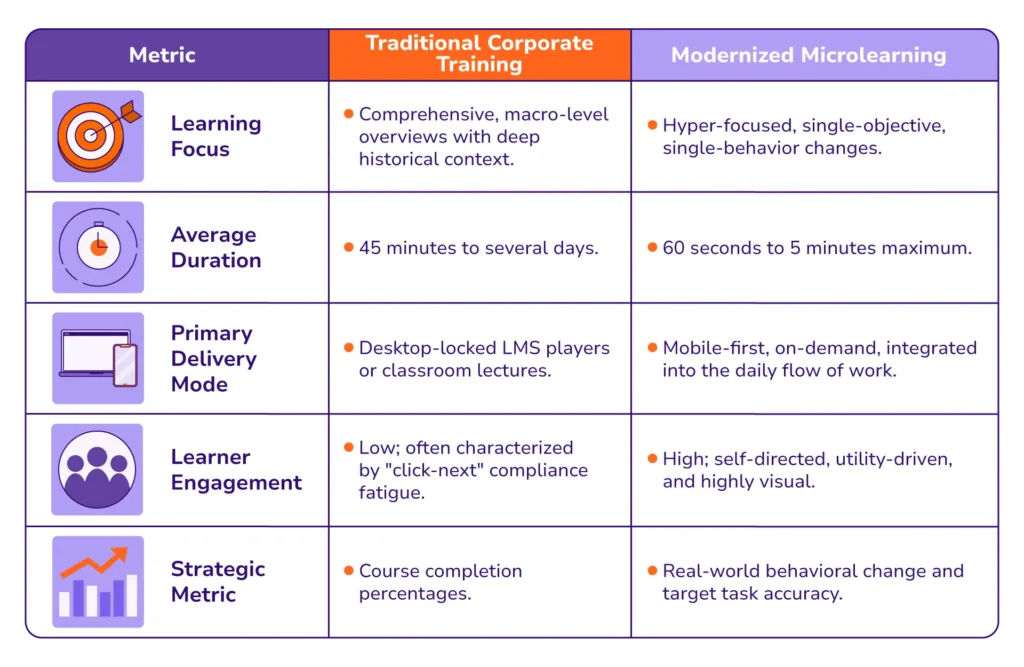
Traditional vs. Modernized Microlearning: A Quick Comparison
When moving away from macro-training architectures, the fundamental design approach changes across every metric.
A 4-Step Framework for Deploying Microlearning Content Solutions
Transforming large-scale training materials into modern, agile assets requires a highly disciplined content-to-media pipeline.
Step 1: Content Audit and Deconstruction
Gather your existing slide decks, manuals, and recordings. Identify the specific sections where participant involvement regularly plummets or where post-training performance measures remain low. Strip out all historical background, conceptual models, and secondary “nice-to-know” statistics. Focus strictly on the “need-to-know” data that dictates action.
Step 2: Apply the “One Behavior” Rule
Review the core objectives of your training document. If a module aims to teach an employee “how to run a sales call, use the CRM, and fill out an expense report,” split it into separate modules immediately. That isn’t one module; it is three completely independent microlearning content solutions. If your learning objective requires the word “and,” your scope is still too broad.
Step 3: Map Content to Visual Media
Microlearning relies heavily on visual communication to maximize rapid comprehension. Match your isolated training chunks to the optimal visual format. Use high-fidelity screencasts for software workflows, character-driven animations for soft skills or behavioral compliance, and live-action video or 360-degree simulations for physical space orientation. You can review a wide range of these delivery styles throughout various industries in our video production portfolio.
Step 4: Keep the Script Audio-First and Natural
Write your narration for the ear, not the eye. Refrain from complex, multi-clause sentences or heavy business speak. Employ active voice and write succinct sentences that allow a voice actor or an AI avatar to maintain an energetic, natural cadence. Always include specific visual instructions alongside your script text such that on-screen actions drive the story forward.
Practical Microlearning Examples in Corporate Environments
To help your instructional design team visualize what this looks like in practice, here are three highly successful microlearning examples deployed across modern organizations:
1. The 90-Second Software Quick-Hit
Instead of forcing a sales rep to complete a 45-minute system onboarding course, the team deploys a series of 90-second interactive screencasts. When a rep forgets how to log an outbound call, they don’t open the LMS catalog; they type “log call” into their internal chat tool and immediately pull up a hyper-focused video showing a mouse clicking the exact interface elements required.
2. The Scenario-Based Branching Animation
For customer de-escalation or soft-skills training, corporate teams utilize 2-minute character-driven animations. The learner is dropped right into a high-stress scenario (e.g., an upset customer demanding a refund). The video plays out the interaction, poses a single critical decision point, and immediately shows the visual consequence of the employee’s chosen response, driving deep behavioral reflection in under 120 seconds.
3. The On-The-Floor Mobile Safety Prompt
For manufacturing, supply chain, or field operations, short safety clips are attached directly to physical machinery via scannable QR codes. Before performing a complex lockout-tagout procedure, an operator scans the code on their mobile device and watches a 60-second, high-impact visual checklist to confirm their safety steps right before touching the hardware. See how we helped scale high-impact, operational standards across complex distributed workforces in our association case studies.

Working with Experts for Flawless Scale
Modernizing a legacy training ecosystem can quickly overwhelm an in-house L&D team that is already balancing day-to-day administrative tasks. Moving from traditional design to highly visual, short-form media requires specialized scripting, advanced storyboarding, animation pipelines, and precise instructional engineering.
If you are prepared to unlock the trapped value inside your existing manuals, PDFs, and long-form webinars, you do not have to map out the journey alone. At Ninja Tropic, we act as a strategic delivery engine for forward-thinking corporate leaders. We focus on transforming dry, exhaustive documentation into stimulating, behavior-driving learning assets that your workforce will actually look forward to consuming. Head over to our Contact Page today to schedule a strategy session, and let’s work together to turn your corporate content into your ultimate performance advantage.
Frequently Asked Questions (FAQs)
What is the ideal length for a modernized corporate microlearning asset?
While microlearning typically spans 60 seconds to 3 minutes, the actual time is secondary to its focus. The defining trait of true microlearning is that it targets a single specific concept, skill, or behavioral outcome, lacking extraneous information.
Does switching to microlearning mean we lose deep foundational context?
Not at all. Microlearning can be layered strategically as part of a blended learning model. Traditional instructional design can still be used to establish deep, baseline structural theories, while modern microlearning modules are deployed immediately afterward to strengthen specific concepts, combat the forgetting curve, and offer on-the-job performance support.
How do we avoid losing context when chopping up long-form training courses?
The key is to avoid simply “chopping up” an existing recording. If you take a 60-minute webinar and randomly split it into 10 6-minute files, the overarching context is lost, rendering the training confusing. Each micro-module must be natively rewritten, re-scripted, and designed as a standalone visual experience with its own hook, a single instructional step, and a direct call to action.
Leave a Reply