When is 3D animation for safety training worth the investment?
3D animation for safety training is worth it when organizations need to visualize hazardous environments too dangerous to film, demonstrate equipment that hasn’t been built yet, or reveal internal mechanical processes from angles a physical camera cannot reach. While producing an industrial training animation requires a higher initial budget than standard 2D graphics or live-action video, the investment pays off by letting safety managers replicate major failures, demonstrate exact lockout-tagout procedures, and expose internal machinery workings without stopping production or risking employee lives.
Let’s confront the elephant in the room: 3D animation costs more. When safety managers and L&D leads source vendors for a new training initiative, the price tag for 3D modeling and rendering can cause sticker shock. The immediate reaction is often, “Why can’t we just send someone out to the warehouse with a camera, or build a simple 2D cartoon?”
For standard corporate policies or basic ergonomics, a live-action shoot or 2D animation is perfectly adequate. However, in heavy industrial, manufacturing, and farming settings, standard video formats hit a hard physical limit. When the subject matter involves high-velocity machinery, confined spaces, or severe chemical hazards, a basic safety training video cannot capture the necessary detail to keep workers safe. In this guide, we will break down when to allocate budget for 3D animation and how to measure its return on investment. To see how we build high-fidelity visual ecosystems, explore our custom eLearning services.

3 Situations Where 3D Animation is the Only Solution
When deciding whether to upgrade to 3D, consider the physical limitations of your training environment. 3D animation training is essential in these three scenarios.
1. Hazardous Environments That Cannot Be Filmed
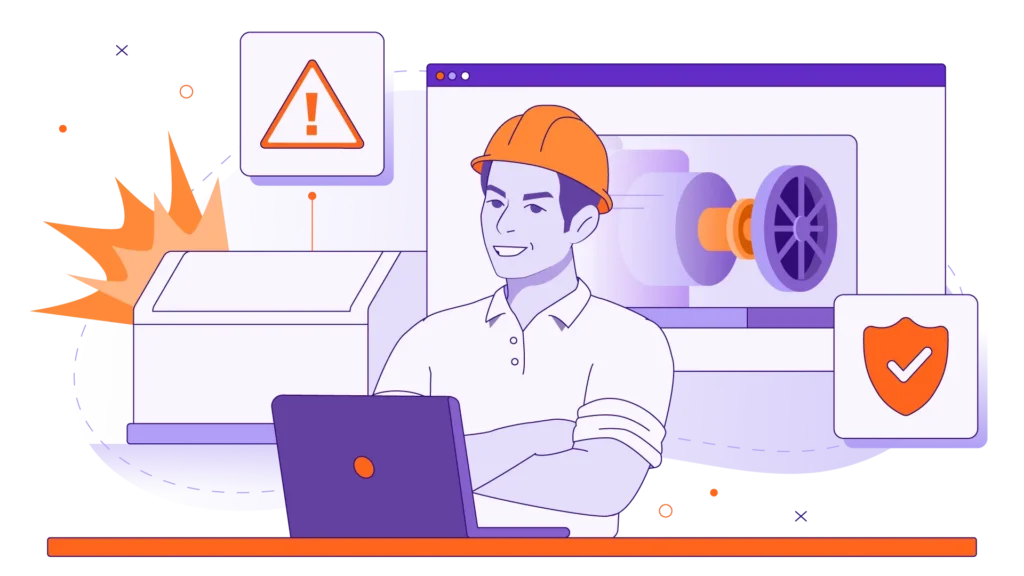
You cannot put a camera crew inside an active blast furnace, beneath a failing trench, or next to a highly pressurized chemical leak. Live-action video is useless for showing severe failures because you cannot safely recreate an explosion or a severe equipment malfunction on your factory floor. 3D animation lets you build a flawless digital twin of the hazard, showing employees the exact, terrifying consequences of skipping a safety step without putting anyone in danger.
2. Impossible Camera Angles and “X-Ray” Views
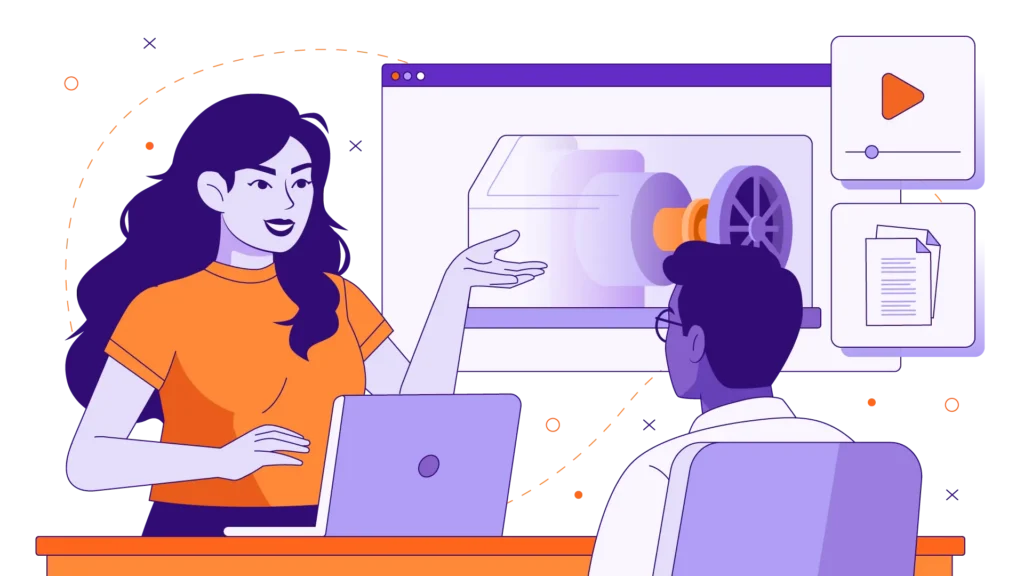
In heavy manufacturing, the most dangerous parts of a machine are often hidden behind heavy steel guards or hidden deep inside an engine block. A camera can only show the machine’s exterior. 3D animation provides an “X-ray” view, allowing you to reveal the exterior layers of a machine to show how gears, blades, and internal pressure systems interact in real time. This level of mechanical transparency is invaluable for lockout-tagout (LOTO) training.
3. Equipment That Doesn’t Exist Yet
If your organization is building a new facility or rolling out proprietary heavy machinery, you cannot wait until the factory is operational to start training. 3D animation lets you import engineers’ CAD files and build realistic industrial training animations months before the physical equipment is installed. By the time the factory doors open, your workforce is already fully certified to operate the machinery safely.
Case Study: Why Oldcastle Chose 3D Animation
To see this stake in action, look at our partnership with Oldcastle, North America’s largest manufacturer of building products and materials.
Oldcastle operates massive industrial facilities with incredibly complex, heavy-duty machinery. They needed a safety training video to demonstrate highly specific, high-risk operational procedures. Filming this live presented several challenges: it would require shutting down a highly profitable production line, and physical cameras couldn’t safely capture the detailed internal workings of the heavy precast concrete machinery.
Rather than compromise on safety, Oldcastle invested in 3D animation. We used their existing CAD files to build exact, high-fidelity digital replicas of their factory floors and machinery. This let us animate the exact lockout-tagout procedures and crane procedures from optimal angles that would be impossible to film. The 3D animation gave Oldcastle’s workforce a level of visual precision live action couldn’t match, creating a safer, more confident workforce without losing a single hour of live production time. Discover similar high-stakes manufacturing projects in our video production portfolio.
The Cost-Versus-Value Framework for Safety Leaders
If you are struggling to justify the cost of 3D animation to your procurement team or executive board, apply this simple cost-versus-value framework to your specific safety challenge.
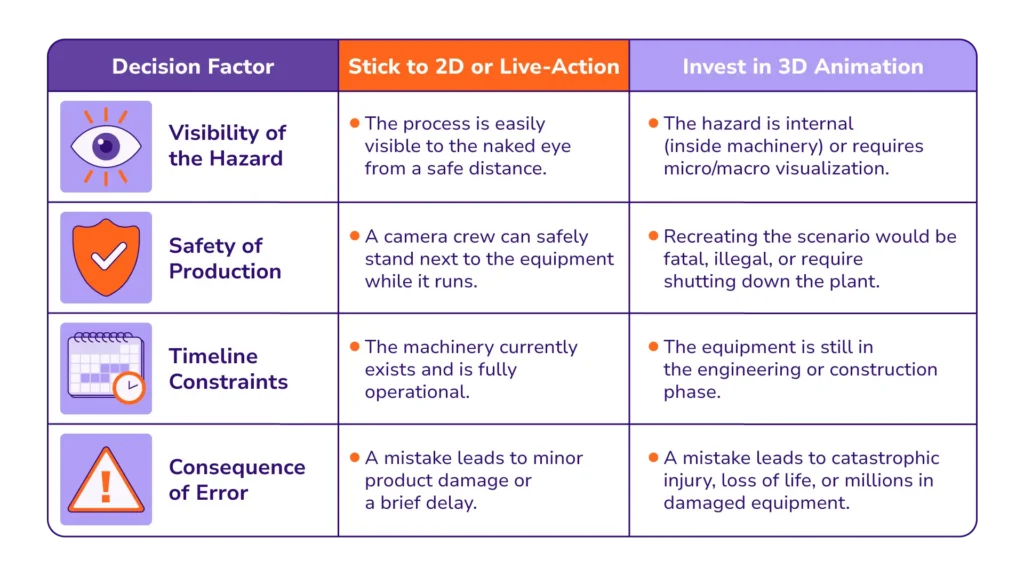
When a training failure could cost lives or destroy millions of dollars in proprietary machinery, the upfront cost of 3D animation is negligible compared to the operational risk.
If your organization relies on high-stakes safety procedures that a standard camera lens can’t capture, it is time to upgrade your visual strategy. Ninja Tropic specializes in converting complex engineering files and safety manuals into striking, life-saving 3D animations. Review our association case studies to see how we reduce risk for large workforces, and contact us via our Contact Page today to discuss your industrial training needs.
Frequently Asked Questions (FAQs)
Why does 3D animation cost more than live-action or 2D video?
3D animation requires specialized software and highly skilled technical artists to build, texture, and light three-dimensional digital objects from scratch. Unlike live-action video, where a camera records what already exists, every single gear, shadow, and movement in a 3D environment must be manually engineered and rendered by a computer, which drastically increases the labor and time required.
Can you use our existing engineering CAD files for 3D animation training?
Yes. Professional animation studios can import your existing CAD (Computer-Aided Design) files directly into 3D animation software. This drastically speeds up 3D modeling, reduces production costs, and ensures the digital machinery in the training video is a mathematically perfect replica of your actual equipment.
When should a manufacturing company use live-action video instead of 3D animation?
Manufacturing companies should use live-action video for peer-to-peer behavioral training, leadership messaging, standard facility tours, or demonstrating basic external safety procedures (like proper lifting techniques or wearing PPE). If the training doesn’t require looking inside a machine or showing a catastrophic failure, live-action is often faster and more cost-effective.