What is the difference between health care training and patient education?
The core difference between healthcare training and patient education consists in the audience and the ultimate metric of success: healthcare training is designed for clinical staff and is judged on strict competency, compliance, and behavior change, whereas patient education is designed for a non-expert audience and is judged by health literacy, comprehension, and post-discharge follow-through. Because a stressed patient processes information differently than a trained nurse learning a new protocol, L&D and marketing leads must use fundamentally different instructional design strategies, manage cognitive demand, and choose different visual tones for each audience.
When hospital systems and healthcare organizations modernize their digital content, L&D and marketing departments frequently blur the line between internal and external learning. They might hire a single vendor to “produce medical videos,” assuming that clinical accuracy is the only requirement for success.
However, clinical accuracy is just the baseline. A video that flawlessly explains the anatomical mechanics of a knee replacement might earn a perfect score from a surgeon, but it could simultaneously terrify and confuse a patient. Separating these two content streams is critical to your organization’s business efficiency and clinical results. At Ninja Tropic, we separate these disciplines into specialized Healthcare Training and Patient Education services because each requires vastly different instructional engineering.
Designing for Clinical Staff Training
When developing clinical staff training, your audience is highly educated professionals, nurses, physicians, and medical technicians, who already have a deep foundation in human anatomy and medical terminology.
This training rarely introduces basic concepts. Instead, it focuses on standardizing operations, onboarding new medical devices, and ensuring strict regulatory compliance.
- The Pedagogy: Clinical training is highly procedural. It utilizes scenario-based branching, high-accuracy simulations, and rigorous assessments intended to test competency under pressure.
- This Tone: Direct, authoritative, and efficient. Clinical staff is notoriously short on time. Training must bypass fluff and deliver the exact “need-to-know” protocols immediately.
- The Metrics of Success: Fewer medical errors, faster onboarding, flawless internal audit scores, and high rates of real-world protocol adoption.
When you need to scale uniform protocols across a massive, distributed hospital network, your instructional design has to prioritize behavioral outcomes over emotional comfort.
The Empathy-First Approach to Patient Education Design
Conversely, patient education design requires profound empathy and strict health-literacy constraints. Your audience isn’t medical experts; they are everyday people who are often frightened, in pain, or overwhelmed by a new, life-altering diagnosis.
When a patient is stressed, their cognitive demand is severely compromised. They cannot absorb complex medical terminology or multi-step clinical theories.
- The Pedagogy: Patient education relies heavily on microlearning, breaking down discharge instructions or disease management into bite-sized, 2-minute videos. It focuses heavily on the “what” and the “how,” minimizing the deep clinical “why” unless it directly helps understanding.
- The Mood: Comforting, reassuring, and completely free of medical jargon. The visual design should reduce anxiety using calm colors, relatable characters, and plain-language on-screen text.
- The Metrics of Success: Increased medication adherence, reduced hospital readmission rates, fewer post-op phone calls to the nursing station, and higher patient satisfaction scores (HCAHPS).
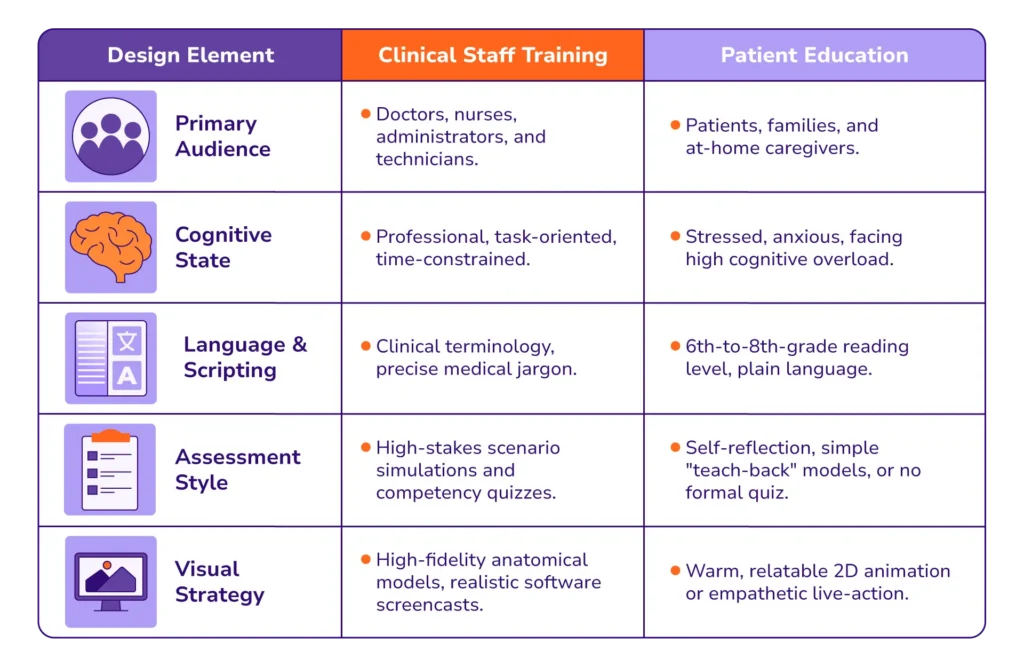
Healthcare Training vs. Patient Education: A Strategic Comparison
To help your healthcare organization plan its content strategy, here is how the system frameworks differ across key metrics:
How to Decide Which Solution You Actually Need
If your organization is preparing a Request for Proposal (RFP) for a new learning initiative, you must define the exact business problem you are trying to solve before selecting a design approach.
You need Healthcare Training if:
- You are rolling out a new Electronic Health Record (EHR) system.
- Your hospital is experiencing a spike in specific procedural mistakes or safety incidents.
- You need to quickly onboard traveling nurses to your facility’s particular protocols.
You need Patient Education if:
- Your post-op nursing staff is overwhelmed by repetitive discharge questions.
- Patients frequently fail to properly prep for scheduled procedures, causing costly cancellations.
- Your hospital’s readmission metrics for chronic conditions (like heart failure or diabetes) are dangerously high.
Whether you want to sharpen your workforce’s clinical competency or drastically improve patients’ at-home recovery, the right instructional framework is the only way to achieve measurable results. If you need a partner who understands the nuances of both audiences, Ninja Tropic is ready to help. Review our dedicated Healthcare Training and Patient Education services to learn about our particular methodologies, and contact us via our Contact Page to discuss your organization’s next major initiative.
Frequently Asked Questions (FAQs)
Why is patient education design so different from standard eLearning?
Patient education design needs to account for the extreme cognitive and emotional distress patients face when receiving medical information. Unlike standard eLearning, which focuses on professional competency, patient education uses plain language (typically a 6th-grade reading level), empathetic visuals, and microlearning to ensure comprehension without increasing anxiety.
What is the main goal of clinical staff training?
The primary goal of clinical staff training is to ensure competency, standardize procedures, and maintain regulatory compliance across a medical institution. It aims to change or strengthen specific clinical behaviors that directly affect patient safety and hospital efficiency.
Can one video serve both healthcare training and patient education?
No. Using a single video for both audiences will make the content either too simplistic for a trained clinician or too complex and frightening for a patient. Each audience requires dedicated scripting, distinct visual design, and completely different pedagogical goals.